PapaKoala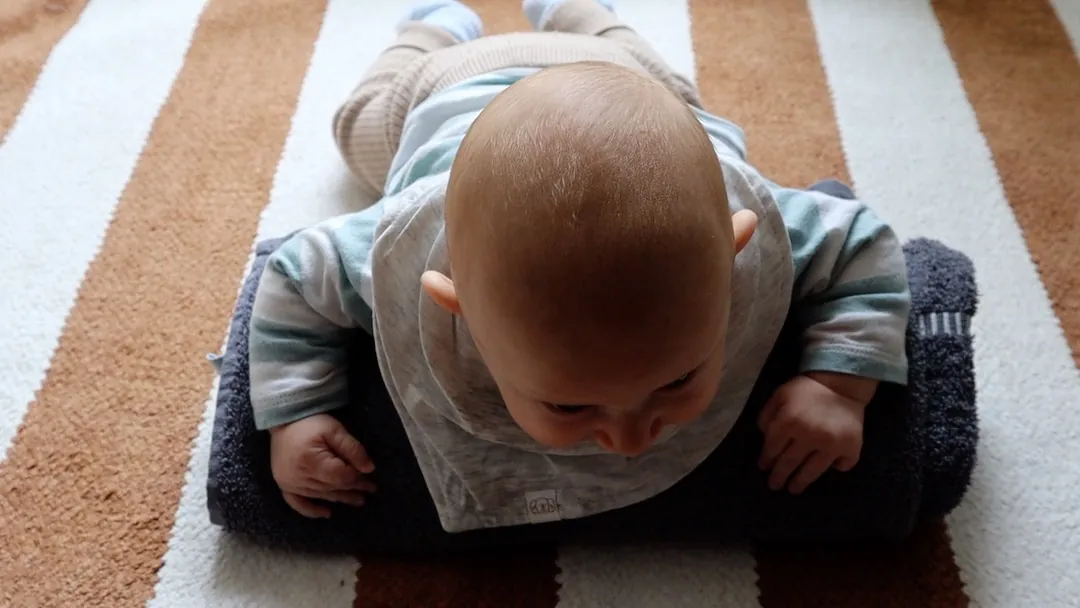
Tummy time over a roll
You rest their chest on a rolled-up towel, and from a little higher than the floor, they try lifting their head to look around.
To do with your baby in the first 4 months. It works on: balance, upper body strengthening and tummy Time. You'll need: blanket and bath towel.
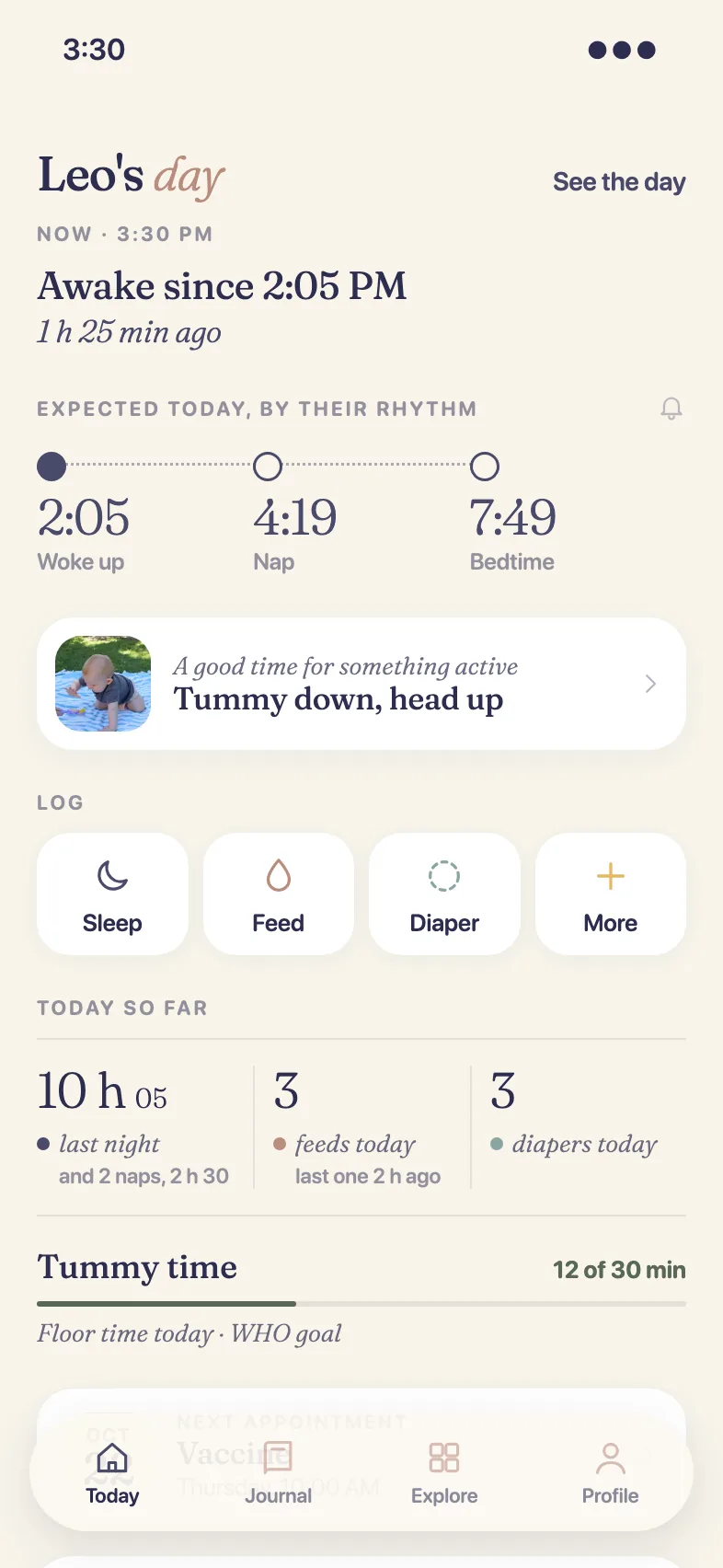
In the app, one activity a day for their age
What do I need?
- Blanket
- Bath towel
How do I do it?
Make the roll
Roll up a large bath towel or a blanket into a firm cylinder about 10–12 cm (4–5 in) across.
Rest their chest on it
Lay your baby tummy-down over the roll, with their chest and upper tummy resting on it. Their arms go out in front and their legs stretch out behind.
Keep their face clear
Stay close the whole time. When they get tired and rest their head, gently turn it to one side so their nose stays clear, or leave it for today.
Watch them try
Notice how, from up there, they try lifting their head to look around. At first they'll hold it up for 5 to 10 seconds, then a little longer each time.
Repeat through the day
Play like this for 2 or 3 minutes, a few times a day. If they get frustrated or start to fuss, leave it for today.
Take care
Stay right beside them the whole time they're on the roll, with their nose and mouth clear. For sleep, always lay them on their back.
What are they learning?
From the roll they can see what's around them, which makes them want to lift their head and look. That works their neck, shoulders and upper back. Time on their tummy also helps keep the back of their head from getting flat.
- Movement
- Hands
- Senses
- Language
- Feelings and connection
- Thinking and play
Balance
Adjusts their body on the roll to keep from tipping to one side
Upper body strengthening
Works their neck, shoulders and back as they lift their head
Tummy Time
Spends some time on their tummy, a little higher than on the floor
What the research says
How trying out many different positions ties into babies' early movement
Dusing · 2016What tummy time does for a 4-month-old's motor milestones
Dudek-Shriber & Zelazny · 2007A review of what research says about tummy time and baby health
Hewitt et al. · 2020
See all 6 references
- Dusing SC. Postural variability and sensorimotor development in infancy. Developmental medicine and child neurology. 2016;58 Suppl 4:17-21. doi:10.1111/dmcn.13045 doi.org/10.1111/dmcn.13045
- Harbourne RT, Stergiou N. Nonlinear analysis of the development of sitting postural control. Developmental Psychobiology. 2003;42(4):368-377. doi:10.1002/dev.10110 doi.org/10.1002/dev.10110
- Dudek-Shriber L, Zelazny S. The effects of prone positioning on the quality and acquisition of developmental milestones in four-month-old infants. Pediatric Physical Therapy. 2007;19(1):48-55. doi:10.1097/01.pep.0000234963.72945.b1 doi.org/10.1097/01.pep.0000234963.72945.b1
- Bertenthal, B. I., & Von Hofsten, C. (1998). Eye, head, and trunk control: The foundation for manual development. Neuroscience and Biobehavioral Reviews, 22, 515–520.
- Hewitt L, Kerr E, Stanley RM, Okely AD. Tummy Time and Infant Health Outcomes: A Systematic Review. Pediatrics. 2020;145(6):1-27. doi:10.1542/peds.2019-2168 doi.org/10.1542/peds.2019-2168
- Russell DC, Kriel H, Joubert G, Goosen Y. Prone positioning and motor development in the first 6 weeks of life. South African Journal of Occupational Therapy. 2009;39(1):11-14.
Reviewed by Javier Atance Ibar, PhD in Education