PapaKoala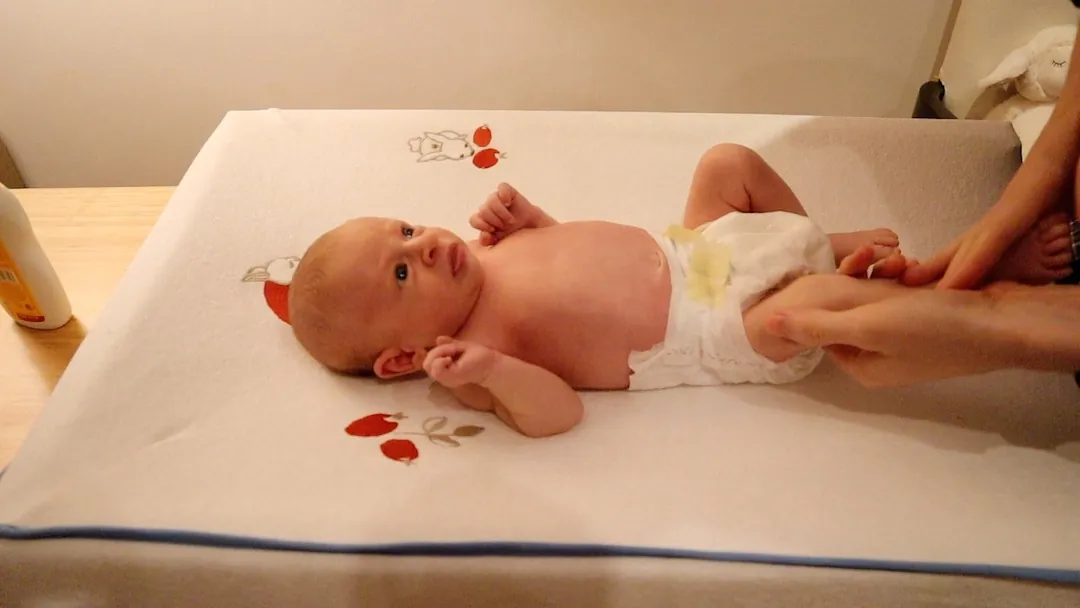
After-bath massage
After the bath, you give them a head-to-toe massage, and they discover each part of their body through your hands.
To do with your baby in the first 4 months. It works on: touch, body awareness and gentle touch. You'll need: hands, moisturizing cream or oil and bath towel.
In the app, one activity a day for their age
What do I need?
- Hands
- Moisturizing cream or oil
- Bath towel
How do I do it?
Set up the spot
After the bath, lay your baby on their back on a bath towel, on the changing table or the bed. Put a little unscented baby cream or oil in your hands and rub them together to warm it.
Massage the legs
Wrap your hands around one leg and slide them slowly from the thigh down to the foot. Then gently massage the foot and repeat with the other leg.
Move on to the arms
Stroke each arm from the shoulder down to the palm. Encourage them to stretch their arms out, but if they keep them bent, don't force it.
Stroke the tummy
Draw gentle circles on their tummy, going clockwise.
Finish with the face
With no cream left on your fingers, rest them in the middle of their forehead and slide them out toward the temples. Then gently massage the bridge of their nose. If they start to fuss, leave it for today.
Take care
If they're on the changing table, always keep one hand on them. Massage their face without cream or oil, so none gets in their eyes.
What are they learning?
Your hands soothe them, and feeling them on their legs, arms, tummy and face, they start to learn where each part of their body is. It's quiet, close time for the two of you. If you do it every night after the bath, it becomes part of the bedtime routine.
- Movement
- Hands
- Senses
- Language
- Feelings and connection
- Thinking and play
Touch
Feels your hands and the warm cream gliding over their skin
Body awareness
Senses where their legs, arms, tummy and face are
Gentle touch
Settles with the touch of your hands after the bath
What the research says
How the sense of touch develops
Bremner & Spence · 2017How babies sense themselves through what they do
Rochat · 1998Touch softens how a baby's body reacts to stress
Feldman et al. · 2010
See all 8 references
- Bremner AJ, Spence C. The development of tactile perception. Advances in Child Development and Behavior. 2017;52:227-268. doi:10.1016/bs.acdb.2016.12.002 doi.org/10.1016/bs.acdb.2016.12.002
- Miguel HO, Gonçalves ÓF, Cruz S, Sampaio A. Infant brain response to affective and discriminative touch: A longitudinal study using fNIRS. Social Neuroscience. 2019;14(5):571.
- Rochat P. Self-perception and action in infancy. Experimental Brain Research. 1998;123(1-2):102-109. doi:10.1007/s002210050550 doi.org/10.1007/s002210050550
- Bremner AJ, Mareschal D, Lloyd-Fox S, Spence C. Spatial localization of touch in the first year of life: early influence of a visual spatial code and the development of remapping across changes in limb position. Journal of Experimental Psychology: General. 2008;137(1):149-162. doi:10.1037/0096-3445.137.1.149 doi.org/10.1037/0096-3445.137.1.149
- Filippetti ML, Lloyd-Fox S, Longo MR, Farroni T, Johnson MH. Neural Mechanisms of Body Awareness in Infants. Cerebral cortex (New York, NY : 1991). 2015;25(10):3779-3787. doi:10.1093/cercor/bhu261 doi.org/10.1093/cercor/bhu261
- Feldman R, Singer M, Zagoory O. Touch attenuates infants' physiological reactivity to stress. Developmental Science. 2010;13(2):271-278. doi:10.1111/j.1467-7687.2009.00890.x doi.org/10.1111/j.1467-7687.2009.00890.x
- Fairhurst MT, Löken L, Grossmann T. Physiological and behavioral responses reveal 9-month-old infants' sensitivity to pleasant touch. Psychological Science. 2014;25(5):1124-1131. doi:10.1177/0956797614527114 doi.org/10.1177/0956797614527114
- Field T, Diego M, Hernandez-Reif M. Moderate pressure is essential for massage therapy effects. International Journal of Neuroscience. 2010;120(5):381-385. doi:10.3109/00207450903579475 doi.org/10.3109/00207450903579475
Reviewed by Javier Atance Ibar, PhD in Education