PapaKoala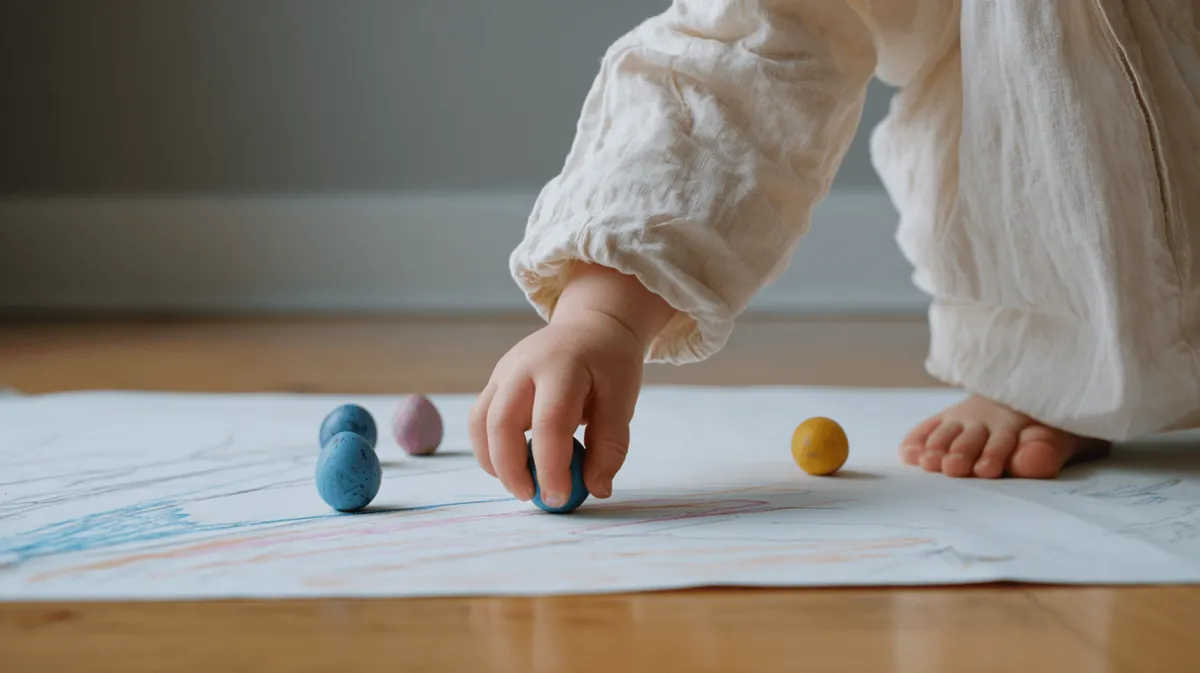
Scribbling on big paper
With a big sheet of paper taped to the floor and some thick crayons, they find out that their arm leaves lines of color.
To do with your toddler between 18 and 24 months. It works on: cause and effect, gross motor skills and visual tracking. You'll need: thick wax crayons, paper tape and large format paper.
In the app, one activity a day for their age
What do I need?
- Thick wax crayons
- Paper tape
- Large format paper
How do I do it?
Set up the paper
Tape a large sheet of paper to the floor or a low table, with paper tape on the corners so it stays put. A regular sheet is too small for how your little one moves at this age. Leave 2 or 3 thick crayons nearby, easy to grip in a fist.
Offer a crayon
Sit down next to them and hand them a crayon. Let them move their arm over the paper however they like: you'll see wide sweeps or quick taps.
Let them explore
Don't ask them to draw anything in particular. If they stop, draw a long line of your own next to theirs and offer the crayon again.
Say what you see
Describe what you see instead of asking “What is it?”: “Look how fast the blue is going!” or “You filled the whole sheet!” Talk about what they're doing, without judging the drawing.
Finish without rushing
Call it a day when they let go of the crayon or wander off to something else. If you like, leave the paper taped down and carry on with it another day.
What are they learning?
They move their whole arm from the shoulder, not just the wrist, so their marks are wide and need room. On a big sheet they can move freely and see that a line of color appears when they move their hand. What interests them is their own movement, not the drawing.
- Movement
- Hands
- Senses
- Language
- Feelings and connection
- Thinking and play
Cause and effect
Discovers that moving the hand with the crayon makes a line of color appear
Gross motor skills
Moves the whole arm from the shoulder in wide sweeps
Visual tracking
Follows the line the crayon leaves as it moves
What the research says
Babies explore more when their movements make something happen
Rovee & Rovee · 1969A big-picture look at how movement develops
Adolph & Franchak · 2017How babies learn to track small and large objects with their eyes
Rosander & von Hofsten · 2002
See all 7 references
- Rovee CK, Rovee DT. Conjugate reinforcement of infant exploratory behavior. Journal of Experimental Child Psychology. 1969;8(1):33-39. doi:10.1016/0022-0965(69)90025-3 doi.org/10.1016/0022-0965(69)90025-3
- Waismeyer A, Meltzoff AN. Learning to make things happen: Infants’ observational learning of social and physical causal events. Journal of Experimental Child Psychology. 2017;162:58-71. doi:10.1016/j.jecp.2017.04.018 doi.org/10.1016/j.jecp.2017.04.018
- Adolph KE, Franchak JM. The development of motor behavior. Wiley interdisciplinary reviews Cognitive science. 2017;8(1-2). doi:10.1002/wcs.1430 doi.org/10.1002/wcs.1430
- Gerber RJ, Wilks T, Erdie-Lalena C. Developmental milestones: motor development. Pediatrics in Review. 2010;31(7):267-277. doi:10.1542/pir.31-7-267 doi.org/10.1542/pir.31-7-267
- Adolph KE, Berger SE, Leo AJ. Developmental continuity? Crawling, cruising, and walking. Developmental Science. 2011;14(2):306-318. doi:10.1111/j.1467-7687.2010.00981.x doi.org/10.1111/j.1467-7687.2010.00981.x
- Rosander K, von Hofsten C. Development of gaze tracking of small and large objects. Experimental Brain Research. 2002;146(2):257-264. doi:10.1007/s00221-002-1161-2 doi.org/10.1007/s00221-002-1161-2
- von Hofsten C, Rosander K. Development of smooth pursuit tracking in young infants. Vision Research. 1997;37(13):1799-1810. doi:10.1016/S0042-6989(96)00332-X doi.org/10.1016/S0042-6989(96)00332-X
Reviewed by Javier Atance Ibar, PhD in Education