PapaKoala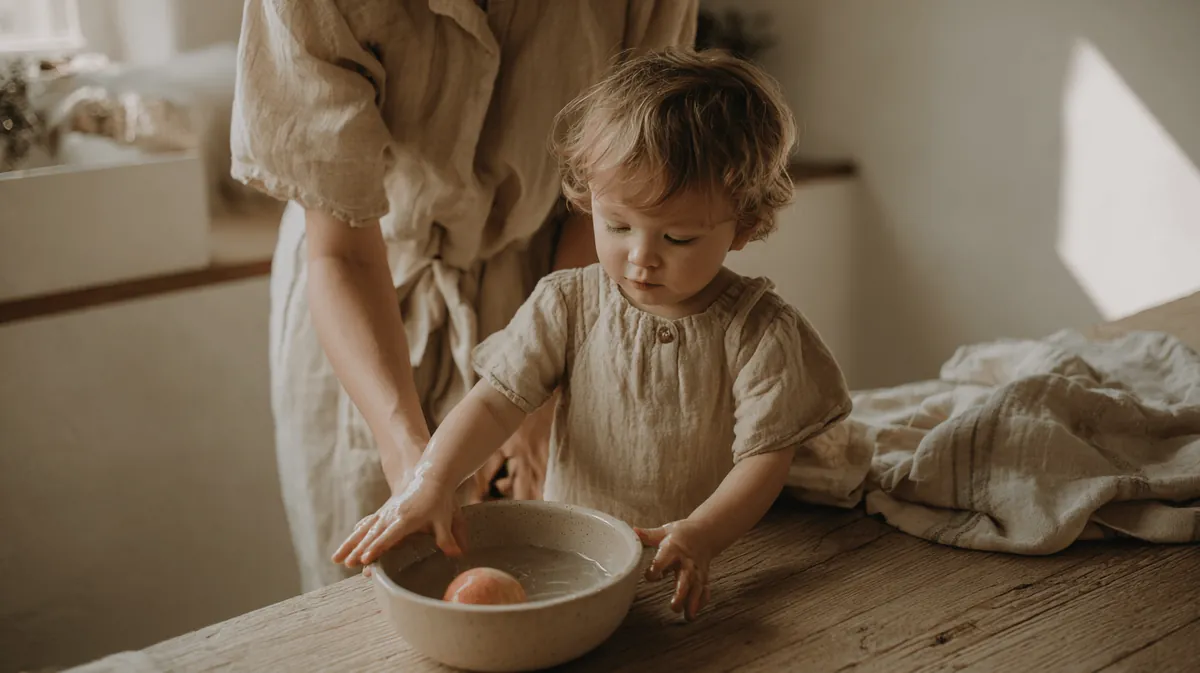
The fruit wash
You wash a piece of fruit in a bowl of water, then they copy you: dip it, rub it and dry it.
To do with your toddler between 18 and 24 months. It works on: fine motor skills, imitation and touch. You'll need: 2-3 pieces of fruit, bowl and soft cotton or microfiber cloth.
In the app, one activity a day for their age
What do I need?
- 2-3 pieces of fruit
- Bowl
- Soft cotton or microfiber cloth
How do I do it?
Set up the fruit wash
Spread a towel on the floor or a low table and set a bowl with a little warm water on it. Add 2 or 3 whole, unpeeled pieces of fruit you'll eat soon, like apples, pears or oranges.
You go first
Sit beside your little one and go slowly so they can watch. Dip a piece of fruit in the water, rub it with your hands, take it out and dry it with the cloth.
Hand them a piece
Give them another piece of fruit and let them wash it their way. If it slips out of their hands, that's fine: they can fish it out of the water again.
Stay close, no rush
Stay with them while they dip, rub and dry the fruit for as long as they like. There's no need to correct them; seeing how you do it is enough.
Finish at the table
When they get tired or start splashing more than washing, carry the fruit to the table together. Thank them: “Thanks for washing the fruit. Now it's clean and ready to eat.”
What are they learning?
Washing fruit is a real job they see you do at home, and here they do it with you: dip, rub and dry before eating. Wet fruit is slippery, so they keep changing their grip so it doesn't slip away.
- Movement
- Hands
- Senses
- Language
- Feelings and connection
- Thinking and play
Fine motor skills
Holds and rubs the wet fruit, adjusting their grip so it doesn't slip
Imitation
Repeats the steps they've seen you do: dip, rub and dry
Touch
Feels the warm water, the smooth skin of the fruit and the dry cloth
What the research says
Motor milestones: what little ones learn to do with hands and body
Gerber et al. · 2010How babies' knack for copying something seen earlier changes from 6 to 24 months
Barr et al. · 1996How the sense of touch develops
Bremner & Spence · 2017
See all 6 references
- Gerber RJ, Wilks T, Erdie-Lalena C. Developmental milestones: motor development. Pediatrics in Review. 2010;31(7):267-277. doi:10.1542/pir.31-7-267 doi.org/10.1542/pir.31-7-267
- Rochat P. Object manipulation and exploration in 2- to 5-month-old infants. Developmental Psychology. 1989;25(6):871-884. doi:10.1037/0012-1649.25.6.871 doi.org/10.1037/0012-1649.25.6.871
- Barr R, Dowden A, Hayne H. Developmental changes in deferred imitation by 6- to 24-month-old infants. Infant Behavior and Development. 1996;19(2):159-170. doi:10.1016/S0163-6383(96)90015-6 doi.org/10.1016/S0163-6383(96)90015-6
- Carpenter M, Nagell K, Tomasello M. Social cognition, joint attention, and communicative competence from 9 to 15 months of age. Monographs of the Society for Research in Child Development. 1998;63(4):1-143. doi:10.2307/1166214 doi.org/10.2307/1166214
- Bremner AJ, Spence C. The development of tactile perception. Advances in Child Development and Behavior. 2017;52:227-268. doi:10.1016/bs.acdb.2016.12.002 doi.org/10.1016/bs.acdb.2016.12.002
- Miguel HO, Gonçalves ÓF, Cruz S, Sampaio A. Infant brain response to affective and discriminative touch: A longitudinal study using fNIRS. Social Neuroscience. 2019;14(5):571.
Reviewed by Javier Atance Ibar, PhD in Education