PapaKoala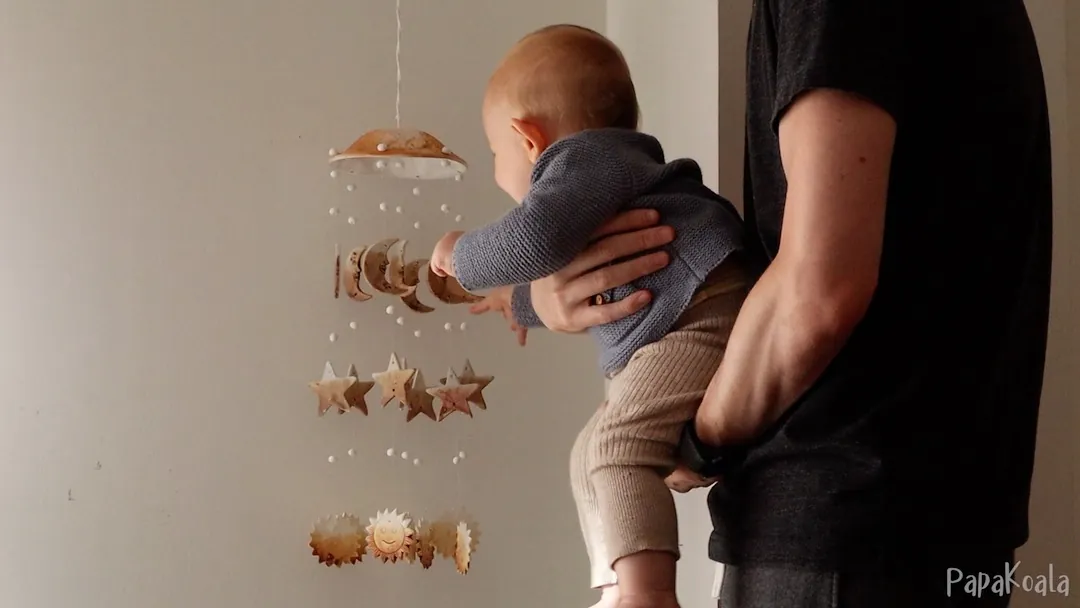
Ringing the musical mobile
You hang a musical mobile within their reach, and they discover that it makes a sound when they touch it.
To do with your baby between 8 and 12 months. It works on: hearing, cause and effect, hand-eye coordination and fine motor skills. You'll need: musical mobile.
In the app, one activity a day for their age
What do I need?
- Musical mobile
How do I do it?
Set up the mobile
Hang a musical mobile from the wall or a doorframe. Put it at a height your baby can reach while standing or from the floor.
Show them the sound
Touch the mobile yourself and say “Listen!” with excitement as it plays. Do it a couple of times, so they connect the movement with the sound.
Help them try
Encourage them with a “Your turn!” Gently take their hand and help them tap the mobile. When it plays, celebrate: “You made it ring!”
Watch them experiment
Let them touch it on their own as much as they like. Notice how they try things out: tapping harder or softer, using different parts of their hand or tapping several times in a row to hear the rhythm.
Wrap up without rushing
When they look away or start to fuss, leave it for today. You can play again another day.
Take care
Hang the mobile securely, with any strings out of their reach, and stay beside them while they play. Afterward, take it down or move it up out of reach.
What are they learning?
Every time they touch the mobile and it plays, they discover that their hand is what makes the sound. Seeing their actions get the same result again and again gives them confidence in what they can do. They also practice guiding their hand with their eyes and adjusting how hard they tap.
- Movement
- Hands
- Senses
- Language
- Feelings and connection
- Thinking and play
Hearing
Hears how the sound changes depending on how hard they tap
Cause and effect
Discovers that touching the mobile makes it ring
Hand-eye coordination
Watches the mobile and guides their hand until they reach it
Fine motor skills
Tries tapping with different parts of their hand, harder or softer
What the research says
Newborns prefer their mother's voice
DeCasper & Fifer · 1980Babies explore more when their movements make something happen
Rovee & Rovee · 1969Eye-hand teamwork in newborn babies
von Hofsten · 1982
See all 8 references
- DeCasper AJ, Fifer WP. Of human bonding: newborns prefer their mothers' voices. Science. 1980;208(4448):1174-1176. doi:10.1126/science.7375928 doi.org/10.1126/science.7375928
- Muir D, Field J. Newborn infants orient to sounds. Child Development. 1979;50(2):431-436. doi:10.2307/1129419 doi.org/10.2307/1129419
- Rovee CK, Rovee DT. Conjugate reinforcement of infant exploratory behavior. Journal of Experimental Child Psychology. 1969;8(1):33-39. doi:10.1016/0022-0965(69)90025-3 doi.org/10.1016/0022-0965(69)90025-3
- Waismeyer A, Meltzoff AN. Learning to make things happen: Infants’ observational learning of social and physical causal events. Journal of Experimental Child Psychology. 2017;162:58-71. doi:10.1016/j.jecp.2017.04.018 doi.org/10.1016/j.jecp.2017.04.018
- von Hofsten C. Eye-hand coordination in the newborn. Developmental Psychology. 1982;18(3):450-461. doi:10.1037/0012-1649.18.3.450 doi.org/10.1037/0012-1649.18.3.450
- Berthier NE, Carrico RL. Visual information and object size in infant reaching. Infant Behavior and Development. 2010;33(4):555-566. doi:10.1016/j.infbeh.2010.07.007 doi.org/10.1016/j.infbeh.2010.07.007
- Gerber RJ, Wilks T, Erdie-Lalena C. Developmental milestones: motor development. Pediatrics in Review. 2010;31(7):267-277. doi:10.1542/pir.31-7-267 doi.org/10.1542/pir.31-7-267
- Rochat P. Object manipulation and exploration in 2- to 5-month-old infants. Developmental Psychology. 1989;25(6):871-884. doi:10.1037/0012-1649.25.6.871 doi.org/10.1037/0012-1649.25.6.871
Reviewed by Javier Atance Ibar, PhD in Education