PapaKoala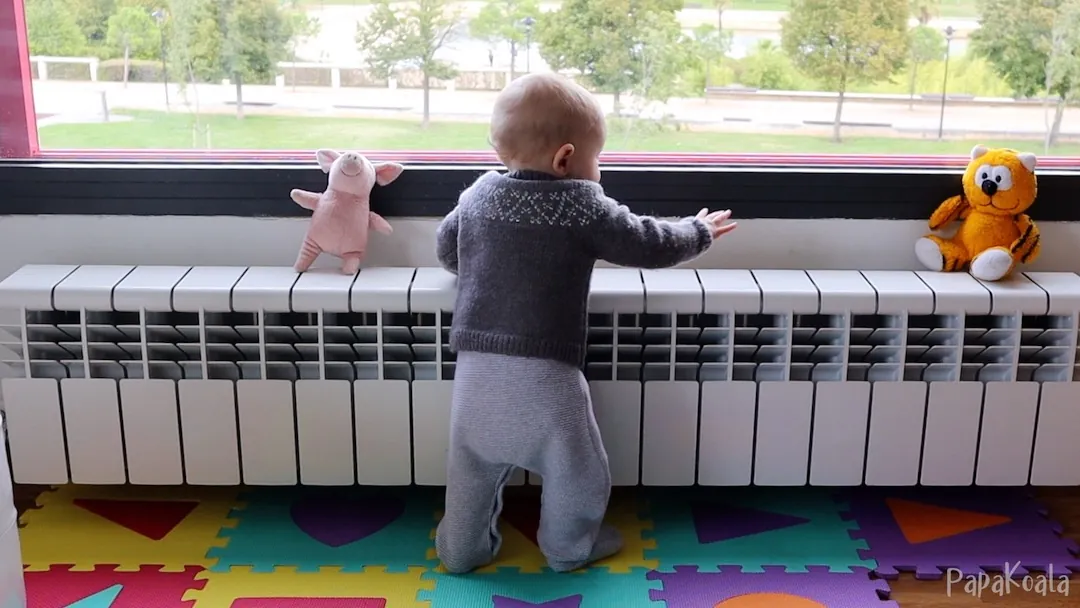
Cruising along the furniture
A toy at the other end of the furniture encourages them to take little sideways steps without letting go.
To do with your baby between 8 and 12 months. It works on: gross motor skills, balance and self confidence. You'll need: sofa, furniture, bed, toy and chair.
In the app, one activity a day for their age
What do I need?
- Sofa
- Furniture
- Bed
- Toy
- Chair
How do I do it?
Set up the furniture
Pick a low, sturdy piece of furniture, like the sofa, the coffee table or a low bed. Put an eye-catching toy on top, at chest height when they're standing.
Help them stand up
Stand your baby facing the furniture, with both hands holding the edge. Watch them take little sideways steps, still holding on, to reach the toy.
Cheer, then switch sides
Cheer when they get there, with a smile or a “Good job!” Then move the toy to the other end of the furniture and encourage them to make the trip back.
Keep going while it's fun
Repeat the trip back and forth for as long as they want to play. If they sit down or lose interest, save it for another time.
Another way to play
Once they're moving with ease, place a chair 30–40 cm (12–16 in) from the furniture. They'll have to let go, take 1 or 2 steps without support and grab the chair, so stay very close for that part.
Take care
Use sturdy furniture that won't slide or tip over, and stay right beside them in case they lose their balance.
What are they learning?
Almost all babies cruise along furniture before they walk without support. Each little step works their hips and ankles, and they practice keeping their balance on the move. Every time they reach the toy, they discover they can get around on their feet, and that builds their confidence.
- Movement
- Hands
- Senses
- Language
- Feelings and connection
- Thinking and play
Gross motor skills
Works their hips and ankles with every sideways step
Balance
Stays steady on their feet while moving
Self confidence
Discovers they can reach the toy on their feet
What the research says
A big-picture look at how movement develops
Adolph & Franchak · 2017How trying out many different positions ties into babies' early movement
Dusing · 2016Babies keep trying longer when they see an adult persist
Leonard et al. · 2017
See all 7 references
- Adolph KE, Franchak JM. The development of motor behavior. Wiley interdisciplinary reviews Cognitive science. 2017;8(1-2). doi:10.1002/wcs.1430 doi.org/10.1002/wcs.1430
- Gerber RJ, Wilks T, Erdie-Lalena C. Developmental milestones: motor development. Pediatrics in Review. 2010;31(7):267-277. doi:10.1542/pir.31-7-267 doi.org/10.1542/pir.31-7-267
- Adolph KE, Berger SE, Leo AJ. Developmental continuity? Crawling, cruising, and walking. Developmental Science. 2011;14(2):306-318. doi:10.1111/j.1467-7687.2010.00981.x doi.org/10.1111/j.1467-7687.2010.00981.x
- Dusing SC. Postural variability and sensorimotor development in infancy. Developmental medicine and child neurology. 2016;58 Suppl 4:17-21. doi:10.1111/dmcn.13045 doi.org/10.1111/dmcn.13045
- Harbourne RT, Stergiou N. Nonlinear analysis of the development of sitting postural control. Developmental Psychobiology. 2003;42(4):368-377. doi:10.1002/dev.10110 doi.org/10.1002/dev.10110
- Leonard JA, Lee Y, Schulz LE. Infants make more attempts to achieve a goal when they see adults persist. Science. 2017;357(6357):1290-1294. doi:10.1126/science.aan2317 doi.org/10.1126/science.aan2317
- Morgan GA, Harmon RJ, Maslin-Cole CA. Mastery motivation: definition and measurement. Early Education and Development. 1990;1(5):318-339. doi:10.1207/s15566935eed0105_1 doi.org/10.1207/s15566935eed0105_1
Reviewed by Javier Atance Ibar, PhD in Education