PapaKoala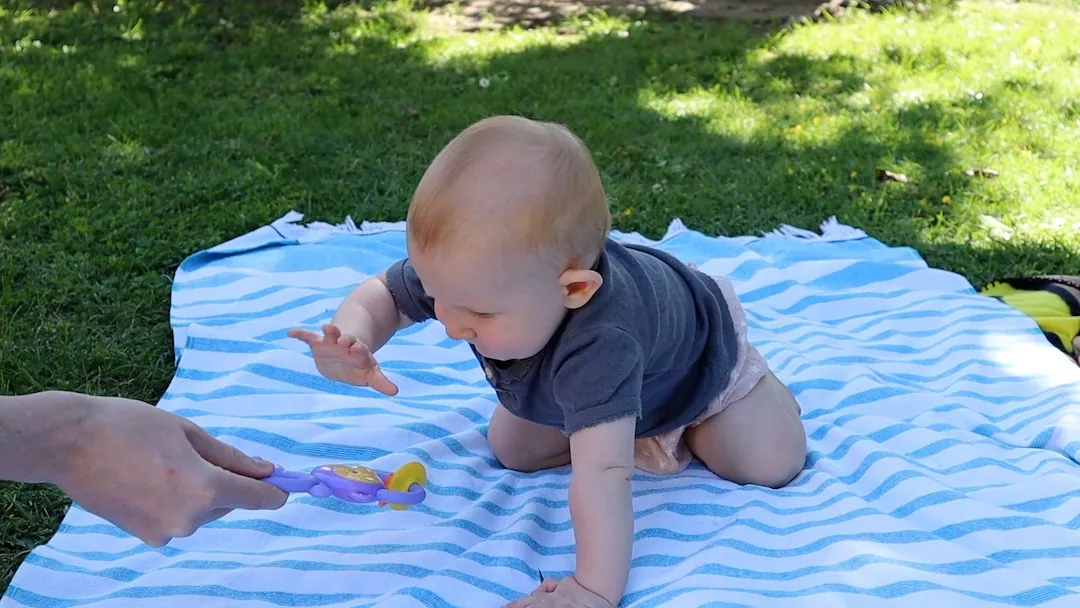
Balancing on all fours
You hold a toy up high so they let go with one hand and stay on all fours, balanced on three points.
To do with your baby between 4 and 8 months. It works on: balance and gross motor skills. You'll need: toy.
In the app, one activity a day for their age
What do I need?
- Toy
How do I do it?
Set up the position
Place your baby on all fours, in a crawling position, on a firm surface. If they can't hold it on their own yet, help them stay there for a few seconds.
Show them the toy
Show them an eye-catching toy, holding it up a little. Encourage them to lift one hand and reach for it: “Grab it!”
Watch them balance
Notice what happens when they lift a hand. They're now holding themselves up on three points: one hand and both knees. You'll see their body shift so they don't tip over.
Switch sides
Offer the toy on the right, then on the left, so they practice with both sides. Keep going as long as they're enjoying the game.
What are they learning?
When they let go with one hand, they balance on three points and use their tummy and lower back muscles to stay up. They'll need that balance to crawl, because crawling means lifting one hand and the opposite knee at the same time.
- Movement
- Hands
- Senses
- Language
- Feelings and connection
- Thinking and play
Balance
Keeps their body steady on three points when they let go with one hand
Gross motor skills
Holds the crawling position with their tummy, back, arms and legs
What the research says
How trying out many different positions ties into babies' early movement
Dusing · 2016A big-picture look at how movement develops
Adolph & Franchak · 2017
See all 5 references
- Dusing SC. Postural variability and sensorimotor development in infancy. Developmental medicine and child neurology. 2016;58 Suppl 4:17-21. doi:10.1111/dmcn.13045 doi.org/10.1111/dmcn.13045
- Harbourne RT, Stergiou N. Nonlinear analysis of the development of sitting postural control. Developmental Psychobiology. 2003;42(4):368-377. doi:10.1002/dev.10110 doi.org/10.1002/dev.10110
- Adolph KE, Franchak JM. The development of motor behavior. Wiley interdisciplinary reviews Cognitive science. 2017;8(1-2). doi:10.1002/wcs.1430 doi.org/10.1002/wcs.1430
- Gerber RJ, Wilks T, Erdie-Lalena C. Developmental milestones: motor development. Pediatrics in Review. 2010;31(7):267-277. doi:10.1542/pir.31-7-267 doi.org/10.1542/pir.31-7-267
- Adolph KE, Berger SE, Leo AJ. Developmental continuity? Crawling, cruising, and walking. Developmental Science. 2011;14(2):306-318. doi:10.1111/j.1467-7687.2010.00981.x doi.org/10.1111/j.1467-7687.2010.00981.x
Reviewed by Javier Atance Ibar, PhD in Education