PapaKoala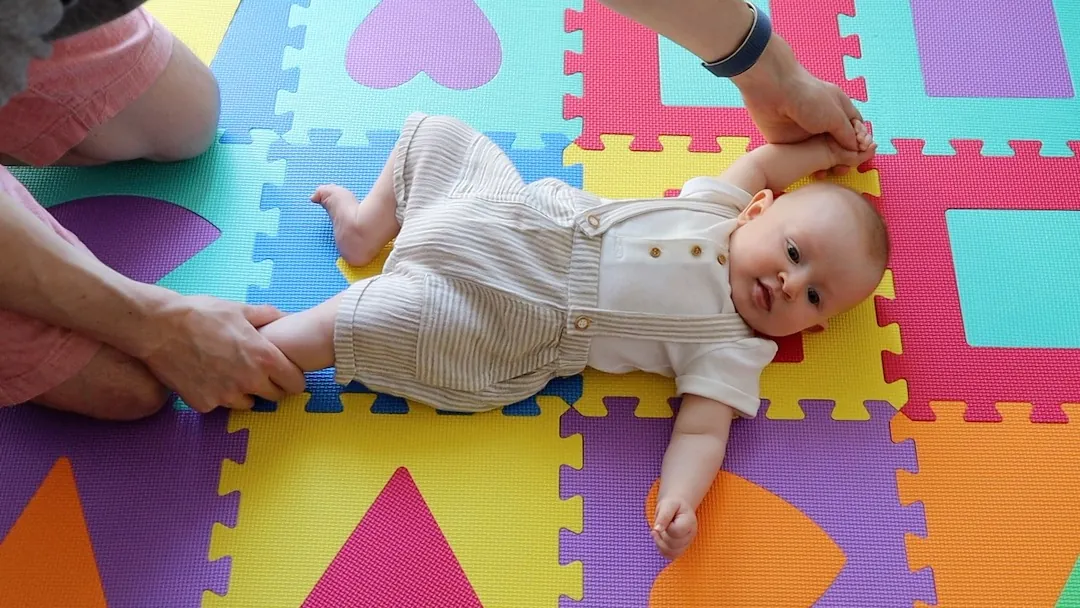
Arm and leg crosses
You gently bring their hand over to the opposite knee, and they feel their arm and leg moving together.
To do with your baby between 4 and 8 months. It works on: body awareness and touch. You'll need: hands.
In the app, one activity a day for their age
What do I need?
- Hands
How do I do it?
Get set up
Lay your baby on their back on a comfortable surface. Pick a time when they're content and in the mood to play.
Cross arm and leg
Hold their right arm in your right hand and their left leg in your left hand. Gently stretch them out, then bring them together, moving their hand toward the opposite knee. Repeat 3 to 5 times.
Switch sides
Do the same with the other pair: their left arm and their right leg.
Alternate the arms
Let go of their legs and take both their hands. Raise one arm above their head while you lower the other beside their hip. Switch 5 or 6 times, as if they were swimming.
End with a gentle touch
Finish by gently stroking their arms and legs. When they look away or start to get fussy, leave it for today.
Take care
Only move their arms and legs as far as they go easily, and stop if they push against you.
What are they learning?
When their hand reaches the knee on the other side, their arm crosses the middle of their body and they feel the two halves meet. Through their skin and muscles, they sense where their arms and legs are, even without looking. As they move their arms as if swimming, they discover that one side can go up while the other goes down.
- Movement
- Hands
- Senses
- Language
- Feelings and connection
- Thinking and play
Body awareness
Feels where their hand and knee are when they meet across their body
Touch
Feels your hands on their arms and legs and their own hand brushing their knee
What the research says
How babies sense themselves through what they do
Rochat · 1998How the sense of touch develops
Bremner & Spence · 2017
See all 5 references
- Rochat P. Self-perception and action in infancy. Experimental Brain Research. 1998;123(1-2):102-109. doi:10.1007/s002210050550 doi.org/10.1007/s002210050550
- Bremner AJ, Mareschal D, Lloyd-Fox S, Spence C. Spatial localization of touch in the first year of life: early influence of a visual spatial code and the development of remapping across changes in limb position. Journal of Experimental Psychology: General. 2008;137(1):149-162. doi:10.1037/0096-3445.137.1.149 doi.org/10.1037/0096-3445.137.1.149
- Filippetti ML, Lloyd-Fox S, Longo MR, Farroni T, Johnson MH. Neural Mechanisms of Body Awareness in Infants. Cerebral cortex (New York, NY : 1991). 2015;25(10):3779-3787. doi:10.1093/cercor/bhu261 doi.org/10.1093/cercor/bhu261
- Bremner AJ, Spence C. The development of tactile perception. Advances in Child Development and Behavior. 2017;52:227-268. doi:10.1016/bs.acdb.2016.12.002 doi.org/10.1016/bs.acdb.2016.12.002
- Miguel HO, Gonçalves ÓF, Cruz S, Sampaio A. Infant brain response to affective and discriminative touch: A longitudinal study using fNIRS. Social Neuroscience. 2019;14(5):571.
Reviewed by Javier Atance Ibar, PhD in Education