PapaKoala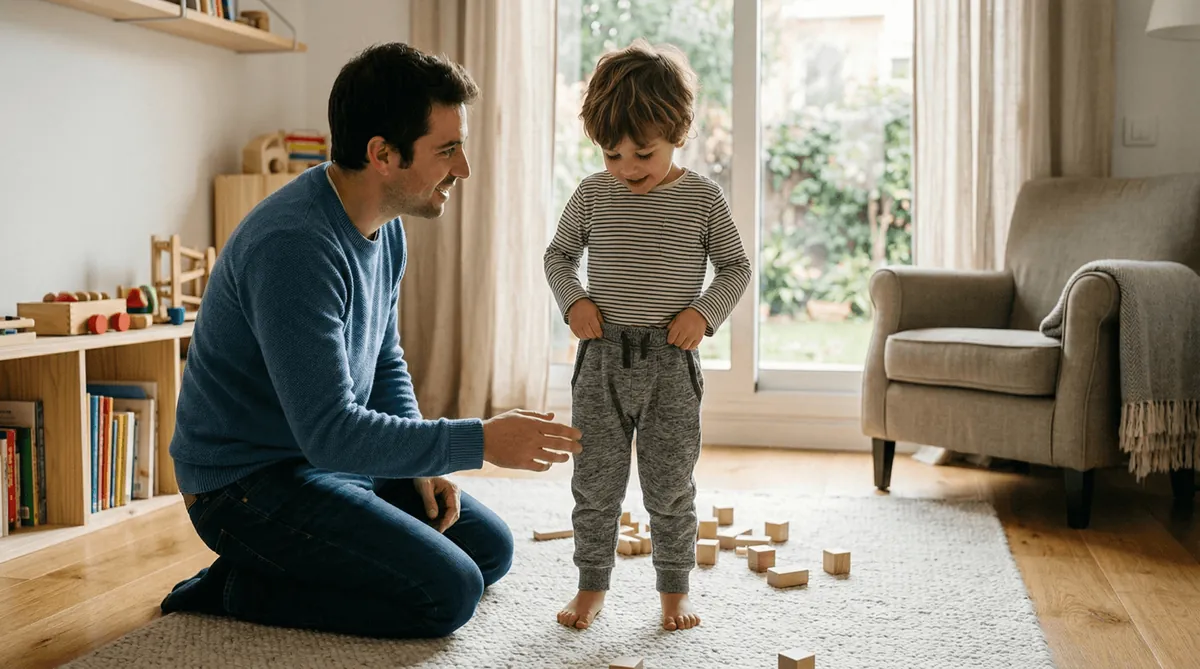
The trouser lift
Their trousers turn into a lift that travels down and up their legs, and they work it with both hands.
To do with your toddler between 2 and 3 years old. It works on: bilateral coordination, body awareness and self confidence. You'll need: loose-fitting trousers with an elastic waistband.
In the app, one activity a day for their age
What do I need?
- Loose-fitting trousers with an elastic waistband
How do I do it?
Set up the game
Pick a quiet playtime, away from bath time or getting dressed. Put your little one in loose trousers with an elastic waistband, like pyjama bottoms or joggers. Stand in front of them and explain the game: “Your trousers are a lift. Which floors can it go to?”
Call the first floor
Ask them to hold the waistband with both hands, one on each side. Give them the first stop: “The lift's going down to your knees. Stop right there!”
Change floors
Keep going with more stops: “Now down to your ankles.” “Going up to your tummy!” If they wobble on the way down to their ankles, they can lean their back against the wall or sit on the floor.
Help if it gets stuck
Free the elastic with one finger if it gets stuck, then let them keep going. Don't move their hands for them: they run the lift with their own.
Finish at the top
Keep playing while they're enjoying it and end with the lift at their tummy. Tell them calmly, “You're really good at running the lift.”
What are they learning?
To pull their trousers down and up without twisting them, they have to tug with both hands at once and with the same strength. Each stop has them find their knees, ankles and tummy while keeping their balance. It's the same movement they'll use when they start using the potty.
- Movement
- Hands
- Senses
- Language
- Feelings and connection
- Thinking and play
Bilateral coordination
Pulls the waistband with both hands at once so the trousers don't twist
Body awareness
Finds their knees, ankles and tummy at each lift stop
Self confidence
Pulls their trousers down and up on their own and sees they can do it
What the research says
Where babies' ability to use both hands together comes from
Corbetta & Thelen · 1996How babies sense themselves through what they do
Rochat · 1998Babies keep trying longer when they see an adult persist
Leonard et al. · 2017
See all 7 references
- Corbetta D, Thelen E. The developmental origins of bimanual coordination: a dynamic perspective. Journal of Experimental Psychology: Human Perception and Performance. 1996;22(2):502-522. doi:10.1037/0096-1523.22.2.502 doi.org/10.1037/0096-1523.22.2.502
- Kimmerle M, Ferre CL, Kotwica KA, Michel GF. Development of role-differentiated bimanual manipulation during the infant's first year. Developmental Psychobiology. 2010;52(2):168-180. doi:10.1002/dev.20428 doi.org/10.1002/dev.20428
- Rochat P. Self-perception and action in infancy. Experimental Brain Research. 1998;123(1-2):102-109. doi:10.1007/s002210050550 doi.org/10.1007/s002210050550
- Bremner AJ, Mareschal D, Lloyd-Fox S, Spence C. Spatial localization of touch in the first year of life: early influence of a visual spatial code and the development of remapping across changes in limb position. Journal of Experimental Psychology: General. 2008;137(1):149-162. doi:10.1037/0096-3445.137.1.149 doi.org/10.1037/0096-3445.137.1.149
- Filippetti ML, Lloyd-Fox S, Longo MR, Farroni T, Johnson MH. Neural Mechanisms of Body Awareness in Infants. Cerebral cortex (New York, NY : 1991). 2015;25(10):3779-3787. doi:10.1093/cercor/bhu261 doi.org/10.1093/cercor/bhu261
- Leonard JA, Lee Y, Schulz LE. Infants make more attempts to achieve a goal when they see adults persist. Science. 2017;357(6357):1290-1294. doi:10.1126/science.aan2317 doi.org/10.1126/science.aan2317
- Morgan GA, Harmon RJ, Maslin-Cole CA. Mastery motivation: definition and measurement. Early Education and Development. 1990;1(5):318-339. doi:10.1207/s15566935eed0105_1 doi.org/10.1207/s15566935eed0105_1
Reviewed by Javier Atance Ibar, PhD in Education