PapaKoala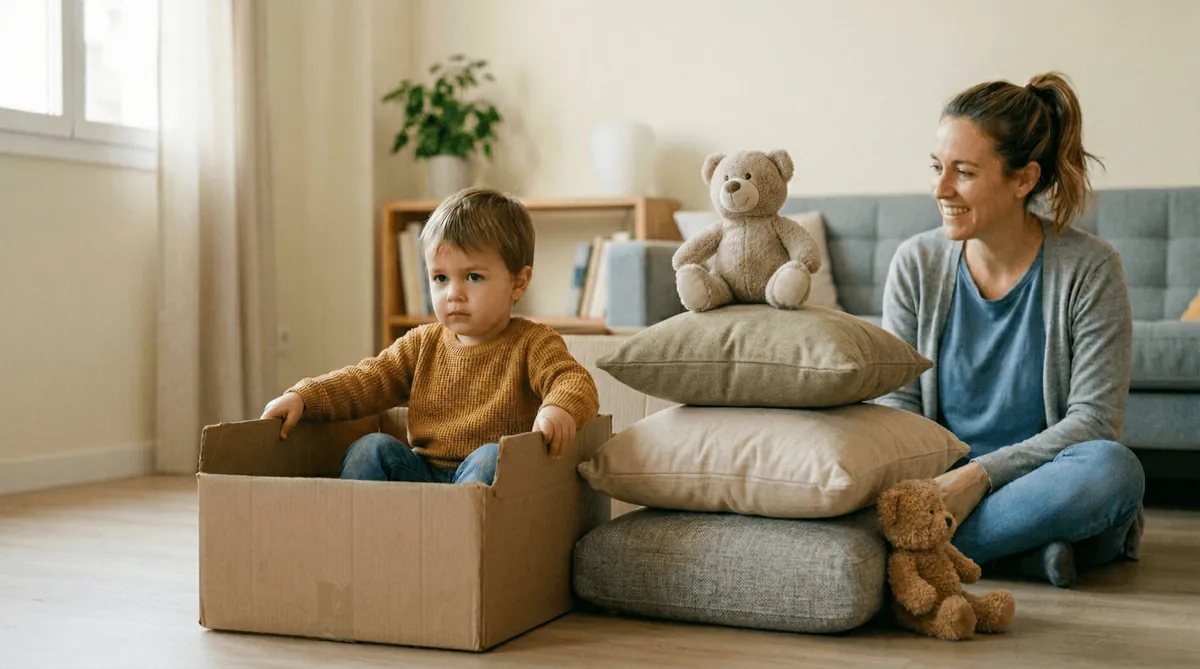
The box train
You turn a row of boxes into a train that travels to made-up stops around the house.
To do with your toddler between 2 and 3 years old. It works on: imitation, language development and symbolic play. You'll need: boxes, sofa cushion and small cuddly toy.
In the app, one activity a day for their age
What do I need?
- Boxes
- Sofa cushion
- Small cuddly toy
How do I do it?
Build the train
Line up 2 or 3 cardboard boxes in the living room and put a sofa cushion in the front one. Invite your little one to sit on the cushion: “All aboard! Who's driving today?” Sit behind them, outside the boxes.
Let them drive
Watch how they settle in, what noises they make and how they move their hands to drive. Don't correct them or tell them what to do. If they stop, add a sound without taking over: “The train goes choo-choo.”
Call out a stop
Give a corner of the house a name: “First stop, Bear Mountain! Let's put your teddy on the train.” Hand them the small cuddly toy so it can ride next to them.
Keep the train going
Make up another stop with its own mission: “Next stop, Snack Station! Shall we get some water for the trip?” If they come up with their own stops, go wherever they say.
Pull into the station
When they lose interest, end the trip calmly: “We're here! Thanks for the ride, driver.” Another day, you can make up new stops together.
What are they learning?
As they play, a few boxes become a train and their cuddly toy becomes a passenger. While driving, they copy the gestures and noises they've seen on trains and in cars. Each stop gives them a new place to name and a little story to follow.
- Movement
- Hands
- Senses
- Language
- Feelings and connection
- Thinking and play
Imitation
Copies the driving gestures and noises they've seen outside the home
Language development
Hears and says the names of the stops and what happens at each one
Symbolic play
Pretends some boxes are a train and their cuddly toy is a passenger
What the research says
How babies' knack for copying something seen earlier changes from 6 to 24 months
Barr et al. · 1996Responding to babbling helps babies quickly learn speech sounds
Goldstein & Schwade · 2008Weighing the evidence on how pretend play affects children's growth
Lillard et al. · 2013
See all 6 references
- Barr R, Dowden A, Hayne H. Developmental changes in deferred imitation by 6- to 24-month-old infants. Infant Behavior and Development. 1996;19(2):159-170. doi:10.1016/S0163-6383(96)90015-6 doi.org/10.1016/S0163-6383(96)90015-6
- Carpenter M, Nagell K, Tomasello M. Social cognition, joint attention, and communicative competence from 9 to 15 months of age. Monographs of the Society for Research in Child Development. 1998;63(4):1-143. doi:10.2307/1166214 doi.org/10.2307/1166214
- Goldstein MH, Schwade JA. Social feedback to infants' babbling facilitates rapid phonological learning. Psychological Science. 2008;19(5):515-523. doi:10.1111/j.1467-9280.2008.02117.x doi.org/10.1111/j.1467-9280.2008.02117.x
- Weisleder A, Fernald A. Talking to children matters: early language experience strengthens processing and builds vocabulary. Psychological Science. 2013;24(11):2143-2152. doi:10.1177/0956797613488145 doi.org/10.1177/0956797613488145
- Lillard AS, Lerner MD, Hopkins EJ, Dore RA, Smith ED, Palmquist CM. The impact of pretend play on children's development: a review of the evidence. Psychological Bulletin. 2013;139(1):1-34. doi:10.1037/a0029321 doi.org/10.1037/a0029321
- McCune L. A normative study of representational play in the transition to language. Developmental Psychology. 1995;31(2):198-206. doi:10.1037/0012-1649.31.2.198 doi.org/10.1037/0012-1649.31.2.198
Reviewed by Javier Atance Ibar, PhD in Education