PapaKoala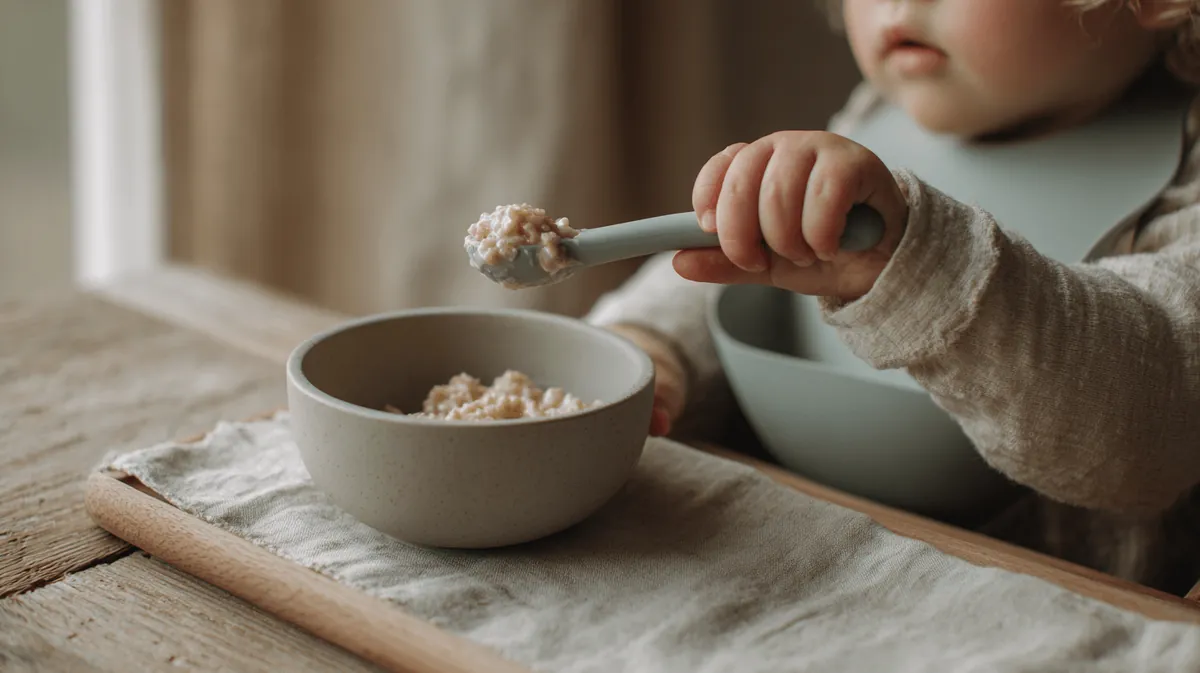
Their own spoon
You hand them a loaded spoon, and they practice bringing it to their mouth without dropping the food.
To do with your toddler between 12 and 18 months. It works on: hand-eye coordination and fine motor skills. You'll need: spoon and medium bowl with food.
In the app, one activity a day for their age
What do I need?
- Spoon
- Medium bowl with food
How do I do it?
Get the food ready
Pick a thick food that sticks to the spoon: thick mashed potatoes, Greek yogurt or stiff oatmeal. Serve it in a medium bowl. Sit your little one at the table and set out two spoons, one for you and one for them.
Hand over a full spoon
Load their spoon yourself and put it in their hand. Invite them to bring it to their mouth without tipping it. At first they'll turn it and the food will fall off, but with practice they'll keep it level all the way.
Let them load it
Wait until they can get it to their mouth without turning it, then encourage them to dig it into the food and load it on their own. Each time it reaches their mouth, cheer with a “Well done!”, even if it arrives empty.
Finish without rushing
Clear the table when they lose interest or start playing with the food. Try again at another meal.
Take care
Stay right beside them the whole time they're eating, and only offer foods they already eat.
What are they learning?
To bring the spoon to their mouth without spilling, they have to adjust their wrist and keep it level the whole way. They look at the bowl, work out where to move their hand and discover that the hollow of the spoon holds the food. It's how they practice feeding themselves.
- Movement
- Hands
- Senses
- Language
- Feelings and connection
- Thinking and play
Hand-eye coordination
Guides the spoon with their eyes from the bowl to their mouth
Fine motor skills
Turns their wrist to keep the spoon level
What the research says
Eye-hand teamwork in newborn babies
von Hofsten · 1982Motor milestones: what little ones learn to do with hands and body
Gerber et al. · 2010
See all 4 references
- von Hofsten C. Eye-hand coordination in the newborn. Developmental Psychology. 1982;18(3):450-461. doi:10.1037/0012-1649.18.3.450 doi.org/10.1037/0012-1649.18.3.450
- Berthier NE, Carrico RL. Visual information and object size in infant reaching. Infant Behavior and Development. 2010;33(4):555-566. doi:10.1016/j.infbeh.2010.07.007 doi.org/10.1016/j.infbeh.2010.07.007
- Gerber RJ, Wilks T, Erdie-Lalena C. Developmental milestones: motor development. Pediatrics in Review. 2010;31(7):267-277. doi:10.1542/pir.31-7-267 doi.org/10.1542/pir.31-7-267
- Rochat P. Object manipulation and exploration in 2- to 5-month-old infants. Developmental Psychology. 1989;25(6):871-884. doi:10.1037/0012-1649.25.6.871 doi.org/10.1037/0012-1649.25.6.871
Reviewed by Javier Atance Ibar, PhD in Education