PapaKoala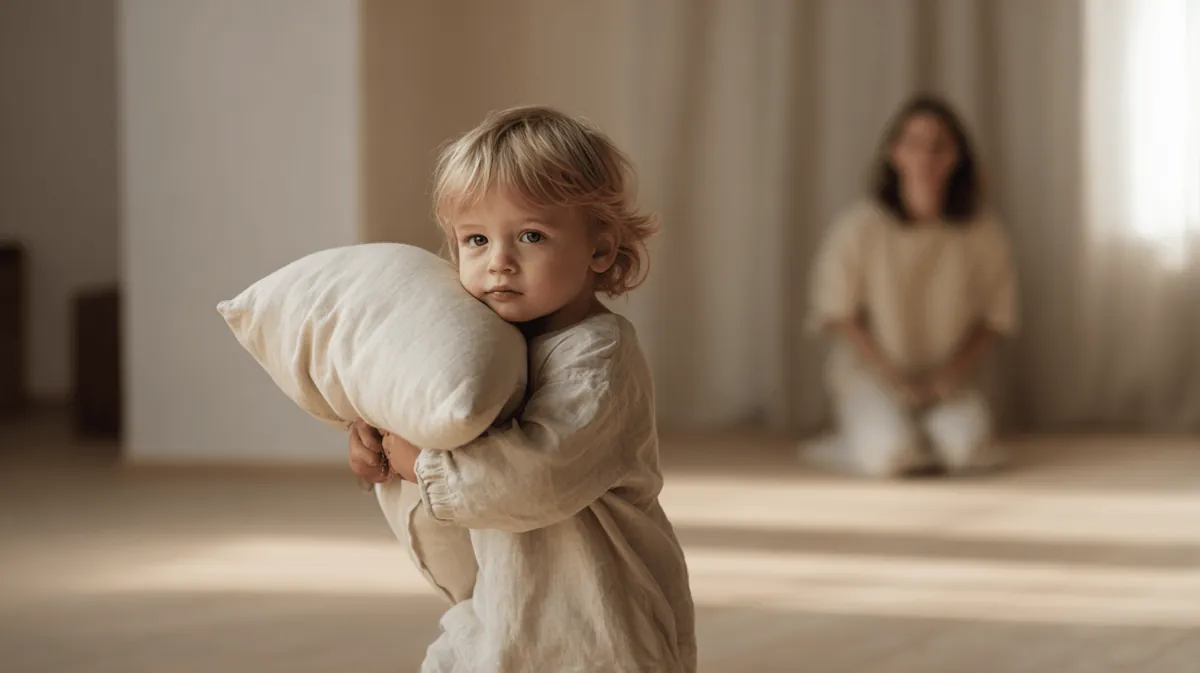
Special delivery
They carry big, very light things over to you in their arms and find out how to walk with a load that hides their feet.
To do with your toddler between 12 and 18 months. It works on: balance, body awareness, gross motor skills, self confidence and spatial awareness. You'll need: boxes, sofa cushion and large toy.
In the app, one activity a day for their age
What do I need?
- Boxes
- Sofa cushion
- Large toy
How do I do it?
Stock the warehouse
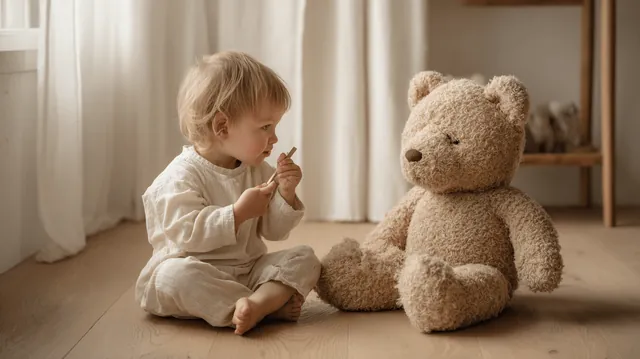
Pick 2 or 3 big, very light things, like a sofa cushion, an empty shoebox or a large stuffed animal. Leave them together at one end of the rug, with the floor clear. Kneel a few steps away, facing your little one.
Hand over the first load
Give them the first one to hug against their chest. From where you are, ask calmly, “Can you bring it to me?”
Take the package
When they reach you, take it without rushing and thank them: “It got here safe and sound, thank you!” Encourage them to go back for the next one.
Keep the deliveries coming
Carry on until the warehouse is empty. If they look away or start to fuss, leave it for another time.
Take care
Keep the route short, on the rug and with the floor clear, because what they're carrying hides their feet. Stay close the whole time.
What are they learning?
With something big in their arms, they can't see their feet and have to adjust each step to keep their balance. They also work out how to get to you with their load. When they hand it over and hear your thanks, they see they've done what they set out to do.
- Movement
- Hands
- Senses
- Language
- Feelings and connection
- Thinking and play
Balance
Keeps their balance while walking with something big in their arms
Body awareness
Feels where their body ends as they hug a big object
Gross motor skills
Walks with a load and adjusts their steps without seeing their feet
Self confidence
Finishes the job and hears your thanks when they arrive
Spatial awareness
Finds their way from the warehouse to where you are
What the research says
How trying out many different positions ties into babies' early movement
Dusing · 2016How babies sense themselves through what they do
Rochat · 1998A big-picture look at how movement develops
Adolph & Franchak · 2017
See all 12 references
- Dusing SC. Postural variability and sensorimotor development in infancy. Developmental medicine and child neurology. 2016;58 Suppl 4:17-21. doi:10.1111/dmcn.13045 doi.org/10.1111/dmcn.13045
- Harbourne RT, Stergiou N. Nonlinear analysis of the development of sitting postural control. Developmental Psychobiology. 2003;42(4):368-377. doi:10.1002/dev.10110 doi.org/10.1002/dev.10110
- Rochat P. Self-perception and action in infancy. Experimental Brain Research. 1998;123(1-2):102-109. doi:10.1007/s002210050550 doi.org/10.1007/s002210050550
- Bremner AJ, Mareschal D, Lloyd-Fox S, Spence C. Spatial localization of touch in the first year of life: early influence of a visual spatial code and the development of remapping across changes in limb position. Journal of Experimental Psychology: General. 2008;137(1):149-162. doi:10.1037/0096-3445.137.1.149 doi.org/10.1037/0096-3445.137.1.149
- Filippetti ML, Lloyd-Fox S, Longo MR, Farroni T, Johnson MH. Neural Mechanisms of Body Awareness in Infants. Cerebral cortex (New York, NY : 1991). 2015;25(10):3779-3787. doi:10.1093/cercor/bhu261 doi.org/10.1093/cercor/bhu261
- Adolph KE, Franchak JM. The development of motor behavior. Wiley interdisciplinary reviews Cognitive science. 2017;8(1-2). doi:10.1002/wcs.1430 doi.org/10.1002/wcs.1430
- Gerber RJ, Wilks T, Erdie-Lalena C. Developmental milestones: motor development. Pediatrics in Review. 2010;31(7):267-277. doi:10.1542/pir.31-7-267 doi.org/10.1542/pir.31-7-267
- Adolph KE, Berger SE, Leo AJ. Developmental continuity? Crawling, cruising, and walking. Developmental Science. 2011;14(2):306-318. doi:10.1111/j.1467-7687.2010.00981.x doi.org/10.1111/j.1467-7687.2010.00981.x
- Leonard JA, Lee Y, Schulz LE. Infants make more attempts to achieve a goal when they see adults persist. Science. 2017;357(6357):1290-1294. doi:10.1126/science.aan2317 doi.org/10.1126/science.aan2317
- Morgan GA, Harmon RJ, Maslin-Cole CA. Mastery motivation: definition and measurement. Early Education and Development. 1990;1(5):318-339. doi:10.1207/s15566935eed0105_1 doi.org/10.1207/s15566935eed0105_1
- Campos JJ, Anderson DI, Barbu-Roth MA, Hubbard EM, Hertenstein MJ, Witherington D. Travel broadens the mind. Infancy. 2000;1(2):149-219. doi:10.1207/S15327078IN0102_1 doi.org/10.1207/S15327078IN0102_1
- Kretch KS, Adolph KE. Cliff or step? Posture-specific learning at the edge of a drop-off. Child Development. 2013;84(1):226-240. doi:10.1111/j.1467-8624.2012.01842.x doi.org/10.1111/j.1467-8624.2012.01842.x
Reviewed by Javier Atance Ibar, PhD in Education