PapaKoala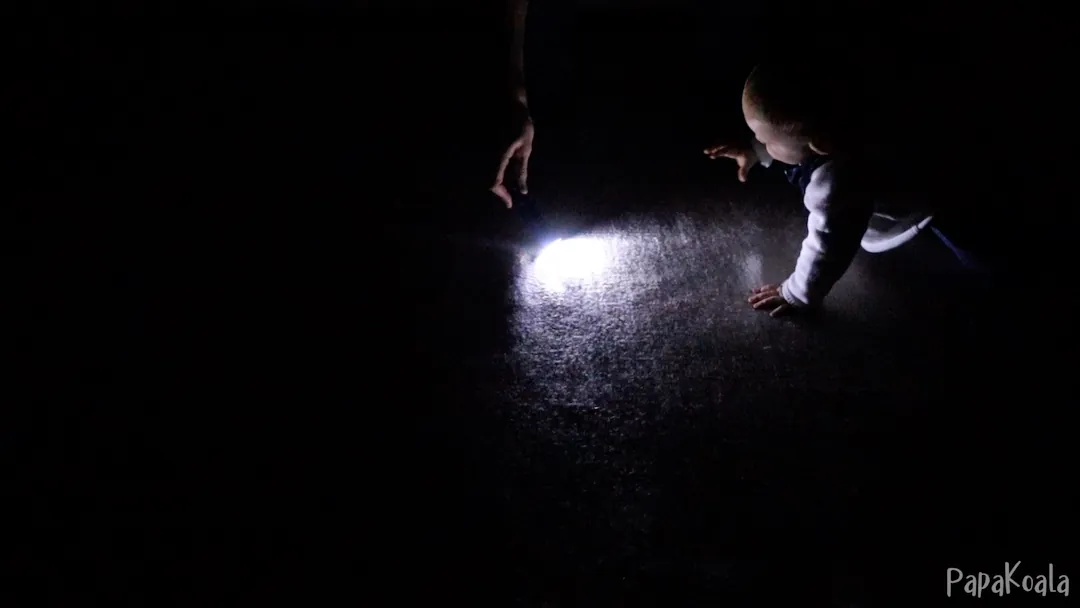
Torch games
In a dimly lit room, you move a torch beam across the wall and they follow the light with their eyes.
To do with your baby between 8 and 12 months. It works on: gross motor skills, visual focus, object tracking and visual discrimination. You'll need: torch and toys.
In the app, one activity a day for their age
What do I need?
- Torch
- Toys
How do I do it?
Dim the lights
Dim the lights in the room. Sit your baby on your lap or on the floor, facing a bare wall.
Move the beam
Turn on the torch and shine it on the wall. Move it slowly, in circles or from side to side.
Play with the light
Switch it off and on in a steady rhythm, saying “Light!” and “Dark!” You can also shine it on nearby toys, one at a time, so they look for each one.
Let them chase it
Watch how their eyes follow the light. If they reach out to catch it, bring the beam closer until they can touch it.
Wind down gently
When they look away or start to fuss, turn the room lights back on and leave it for today.
Another way to play
If they're already crawling, move the beam slowly across the floor, just ahead of them, and let them go after the light.
Take care
Always point the torch at the wall, the floor or the toys, never at their face, and put it away when you're done.
What are they learning?
To follow the spot of light, they have to keep their eyes on it and move them along at the same pace. When the light switches on and off, or lands on a toy, they practise focusing on what stands out. When they try to catch the beam, they guide their hand with their eyes.
- Movement
- Hands
- Senses
- Language
- Feelings and connection
- Thinking and play
Gross motor skills
Twists, stretches or crawls to go after the light
Visual focus
Keeps their eyes on the spot of light for as long as the game lasts
Object tracking
Follows the beam with their eyes as it moves across the wall
Visual discrimination
Tells the lit-up toy apart from the ones left in the dark
What the research says
A big-picture look at how movement develops
Adolph & Franchak · 2017How visual attention develops in babies
Colombo · 2001How young babies learn to follow moving things smoothly with their eyes
von Hofsten & Rosander · 1997
See all 9 references
- Adolph KE, Franchak JM. The development of motor behavior. Wiley interdisciplinary reviews Cognitive science. 2017;8(1-2). doi:10.1002/wcs.1430 doi.org/10.1002/wcs.1430
- Gerber RJ, Wilks T, Erdie-Lalena C. Developmental milestones: motor development. Pediatrics in Review. 2010;31(7):267-277. doi:10.1542/pir.31-7-267 doi.org/10.1542/pir.31-7-267
- Adolph KE, Berger SE, Leo AJ. Developmental continuity? Crawling, cruising, and walking. Developmental Science. 2011;14(2):306-318. doi:10.1111/j.1467-7687.2010.00981.x doi.org/10.1111/j.1467-7687.2010.00981.x
- Colombo J. The development of visual attention in infancy. Annual Review of Psychology. 2001;52:337-367. doi:10.1146/annurev.psych.52.1.337 doi.org/10.1146/annurev.psych.52.1.337
- Courage ML, Reynolds GD, Richards JE. Infants' attention to patterned stimuli: developmental change from 3 to 12 months of age. Child Development. 2006;77(3):680-695. doi:10.1111/j.1467-8624.2006.00897.x doi.org/10.1111/j.1467-8624.2006.00897.x
- von Hofsten C, Rosander K. Development of smooth pursuit tracking in young infants. Vision Research. 1997;37(13):1799-1810. doi:10.1016/S0042-6989(96)00332-X doi.org/10.1016/S0042-6989(96)00332-X
- Rosander K. Visual tracking and its relationship to cortical development. Progress in Brain Research. 2007;164:105-122. doi:10.1016/S0079-6123(07)64006-0 doi.org/10.1016/S0079-6123(07)64006-0
- Vassella F, Giambonini S, Heits B, Kaufmann R, Kehrli P, Wälti U. Development of visual discrimination (pattern preference) in normal infants. Helvetica paediatrica acta. 1977;32(4-5):319-329.
- Farzin F, Rivera SM, Whitney D. Spatial resolution of conscious visual perception in infants. Psychological science. 2010;21(10):1502-1509. doi:10.1177/0956797610382787 doi.org/10.1177/0956797610382787
Reviewed by Javier Atance Ibar, PhD in Education