PapaKoala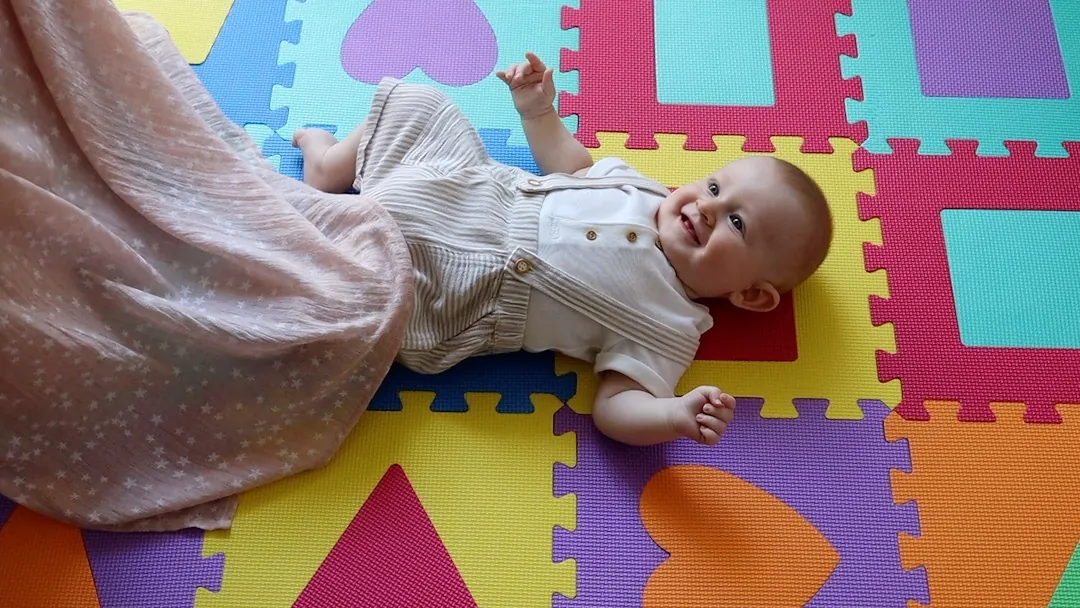
Peekaboo
You hide your face behind a cloth and pop back out with a smile, so they discover you're still there even when they can't see you.
To do with your baby between 4 and 8 months. It works on: visual focus and object permanence. You'll need: soft fabric.
In the app, one activity a day for their age
What do I need?
- Soft fabric
How do I do it?
Get into position
Lay your baby on their back or, if they can already sit, settle them in a steady sitting position. Keep a soft cloth handy (a scarf, a light blanket or your own T-shirt).
Cover your face
Cover your face completely with the cloth. Ask in a playful voice: “Where am I?” Wait 2 or 3 seconds to build a little suspense.
Pop back out
Pull the cloth away quickly and say with a big smile: “Here I am!” Watch how they react: lots of babies burst out laughing.
Play it again
Do it 5 to 10 times. Over time, you'll see them laugh before you even appear, because they're already waiting for your “Here I am!”
Another way to play
Hide their favourite toy under the cloth, with part of it still showing, and ask: “Where is it?” When they pull the cloth away and find it, celebrate: “There it is!”
What are they learning?
Each time you disappear and come back, they discover that people and things are still there even when they can't see them, something many babies start to understand between 4 and 8 months. They also learn to wait for what comes next and to take turns, one of their first steps towards communicating. And they hold on to a reassuring idea: when you go away, you come back.
- Movement
- Hands
- Senses
- Language
- Feelings and connection
- Thinking and play
Visual focus
Keeps their eyes on the cloth while waiting for your face to reappear
Object permanence
Discovers that you're still there even when the cloth hides your face
What the research says
How visual attention develops in babies
Colombo · 2001More evidence that young babies know hidden things still exist
Baillargeon & DeVos · 1991
See all 4 references
- Colombo J. The development of visual attention in infancy. Annual Review of Psychology. 2001;52:337-367. doi:10.1146/annurev.psych.52.1.337 doi.org/10.1146/annurev.psych.52.1.337
- Courage ML, Reynolds GD, Richards JE. Infants' attention to patterned stimuli: developmental change from 3 to 12 months of age. Child Development. 2006;77(3):680-695. doi:10.1111/j.1467-8624.2006.00897.x doi.org/10.1111/j.1467-8624.2006.00897.x
- Baillargeon R, DeVos J. Object permanence in young infants: further evidence. Child development. 1991;62(6):1227-1246.
- Ruffman T, Slade L, Redman J. Young infants’ expectations about hidden objects. Cognition. 2005;97(2):B35-B43. doi:10.1016/j.cognition.2005.01.007 doi.org/10.1016/j.cognition.2005.01.007
Reviewed by Javier Atance Ibar, PhD in Education