PapaKoala
A little errand
You ask them to fetch something they know well and, as they hand it to you, they find out they can help at home.
To do with your toddler between 18 and 24 months. It works on: language development, memory and self confidence. You'll need: everyday objects (shoes, nappy, book).
In the app, one activity a day for their age
What do I need?
- Everyday objects (shoes, nappy, book)
How do I do it?
Pick your moment
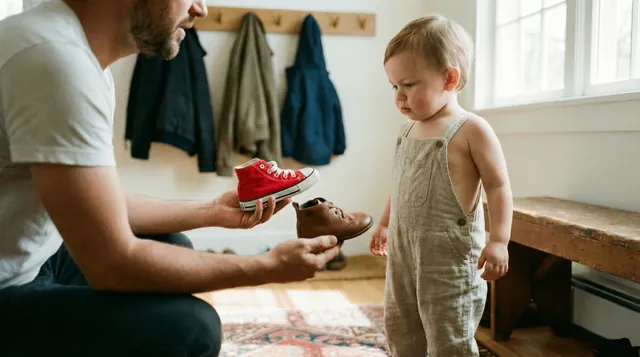
Wait for a time in the day when you need something your little one knows well: their shoes, a nappy or their book. Check it's within reach, with no climbing or stairs to get to it.
Ask for one thing
Call them by name and, once they look at you, ask calmly: “Can you bring me the nappy, please?” Wait 10 to 15 seconds without asking again.
Take what they bring
Smile when they come back and name what they've brought: “Thank you! You brought me the nappy.” If they bring something else, thank them anyway and go together to find the nappy.
Find more errands
Let them help with other simple errands through the day, as long as they're keen. If they don't feel like going today, fetch it yourself and name it as you pick it up.
Another way to play
Once they do it without hesitating, ask for two things at once: “Can you bring me your shoes and your book?”
What are they learning?
To bring you what you asked for, they have to understand the word and remember what the object looks like and where it is. Hearing its name just as they hand it over, they link the word to what's in their hand. Seeing that their help is useful makes them feel capable.
- Movement
- Hands
- Senses
- Language
- Feelings and connection
- Thinking and play
Language development
Understands your request and hears the object's name again as they hand it over
Memory
Remembers what you asked for and where it is while they go to get it
Self confidence
Finds out they can help at home with a simple errand
What the research says
Responding to babbling helps babies quickly learn speech sounds
Goldstein & Schwade · 2008How a baby's brain begins to build a past
Bauer · 2006Babies keep trying longer when they see an adult persist
Leonard et al. · 2017
See all 6 references
- Goldstein MH, Schwade JA. Social feedback to infants' babbling facilitates rapid phonological learning. Psychological Science. 2008;19(5):515-523. doi:10.1111/j.1467-9280.2008.02117.x doi.org/10.1111/j.1467-9280.2008.02117.x
- Weisleder A, Fernald A. Talking to children matters: early language experience strengthens processing and builds vocabulary. Psychological Science. 2013;24(11):2143-2152. doi:10.1177/0956797613488145 doi.org/10.1177/0956797613488145
- Bauer PJ. Constructing a past in infancy: a neuro-developmental account. Trends in Cognitive Sciences. 2006;10(4):175-181. doi:10.1016/j.tics.2006.02.009 doi.org/10.1016/j.tics.2006.02.009
- Hayne H. Infant memory development: implications for childhood amnesia. Developmental Review. 2004;24(1):33-73. doi:10.1016/j.dr.2003.09.007 doi.org/10.1016/j.dr.2003.09.007
- Leonard JA, Lee Y, Schulz LE. Infants make more attempts to achieve a goal when they see adults persist. Science. 2017;357(6357):1290-1294. doi:10.1126/science.aan2317 doi.org/10.1126/science.aan2317
- Morgan GA, Harmon RJ, Maslin-Cole CA. Mastery motivation: definition and measurement. Early Education and Development. 1990;1(5):318-339. doi:10.1207/s15566935eed0105_1 doi.org/10.1207/s15566935eed0105_1
Reviewed by Javier Atance Ibar, PhD in Education