PapaKoala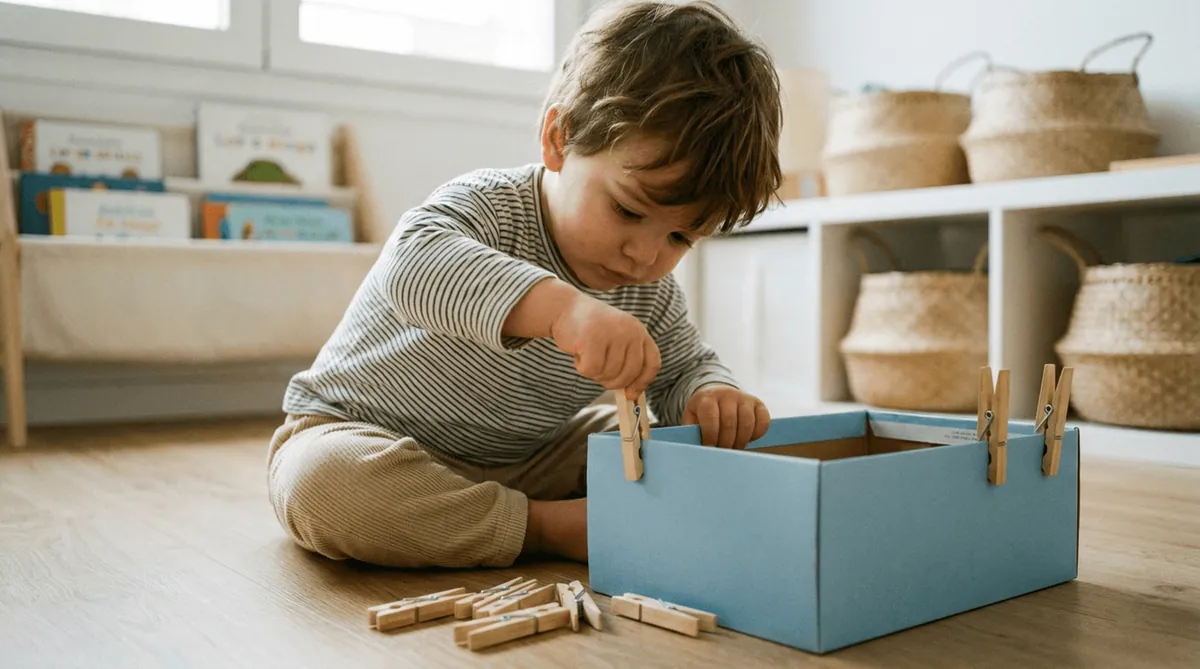
Birds on the nest
Clothespins turn into birds that land on the edge of a box, and your little one squeezes each beak open to clip it on.
To do with your toddler between 2 and 3 years old. It works on: bilateral coordination, hand-eye coordination and pincer grasp. You'll need: 5–6 clothespins and shoebox.
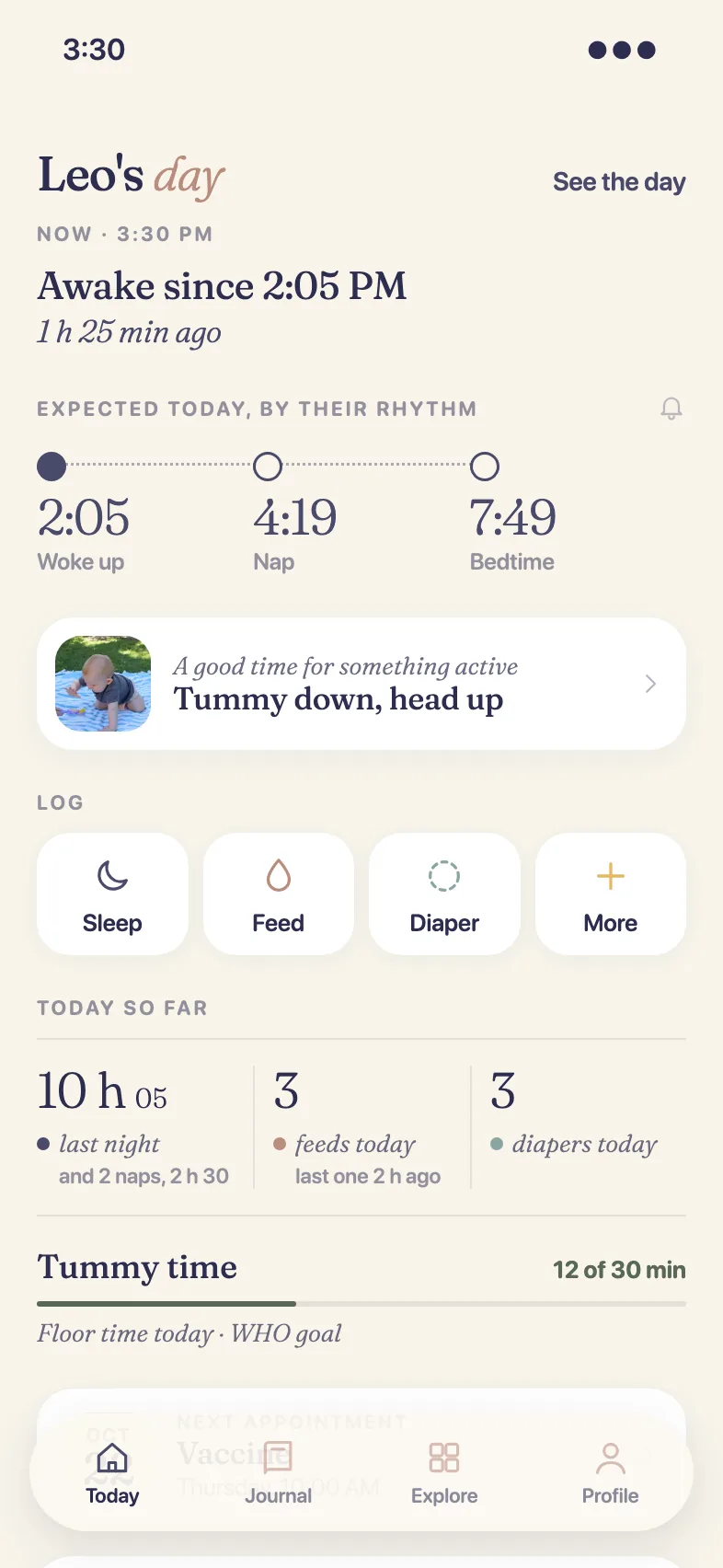
In the app, one activity a day for their age
What do I need?
- 5–6 clothespins
- Shoebox
How do I do it?
Set up the nest
Put an empty shoebox and 5 or 6 clothespins on the floor, within your little one's reach. Introduce the game: “These clothespins are birds. Let's help them land on the edge of their nest.”
Show them the beak
Pick up a clothespin and squeeze the end with two fingers so the beak opens. Clip it onto the edge of the box and let go slowly.
Let them try
Hand them a clothespin and watch as they hold the box with one hand and open the beak with the other. If the clothespin pops off or won't open all the way, wait and give a hint: “Squeeze the bird's beak hard.” Don't open it for them.
Celebrate each bird
Tell them what they did once the first one stays on: “You squeezed the beak and the bird's on its nest.” Keep going until every bird is sitting on the edge.
Pack up the nest
Put the clothespins back in the box together once they lose interest. Play again another day.
Another way to play
Once they've got the hang of it, ask them to take the birds off the edge one at a time, squeezing each beak, and drop them into the nest.
What are they learning?
To open the clothespin, they have to squeeze the beak between thumb and index finger. Meanwhile, the other hand holds the box, so each hand does a different job. They also look at the edge to decide where to let go so the clothespin stays put.
- Movement
- Hands
- Senses
- Language
- Feelings and connection
- Thinking and play
Bilateral coordination
Holds the box with one hand while opening and clipping the clothespin with the other
Hand-eye coordination
Looks at the edge of the box and lets go of the clothespin right where they want it
Pincer grasp
Squeezes the clothespin's beak between thumb and index finger until it opens
What the research says
Where babies' ability to use both hands together comes from
Corbetta & Thelen · 1996Eye-hand teamwork in newborn babies
von Hofsten · 1982A fresh look at a classic study of how babies learn to grasp
Butterworth et al. · 1997
See all 6 references
- Corbetta D, Thelen E. The developmental origins of bimanual coordination: a dynamic perspective. Journal of Experimental Psychology: Human Perception and Performance. 1996;22(2):502-522. doi:10.1037/0096-1523.22.2.502 doi.org/10.1037/0096-1523.22.2.502
- Kimmerle M, Ferre CL, Kotwica KA, Michel GF. Development of role-differentiated bimanual manipulation during the infant's first year. Developmental Psychobiology. 2010;52(2):168-180. doi:10.1002/dev.20428 doi.org/10.1002/dev.20428
- von Hofsten C. Eye-hand coordination in the newborn. Developmental Psychology. 1982;18(3):450-461. doi:10.1037/0012-1649.18.3.450 doi.org/10.1037/0012-1649.18.3.450
- Berthier NE, Carrico RL. Visual information and object size in infant reaching. Infant Behavior and Development. 2010;33(4):555-566. doi:10.1016/j.infbeh.2010.07.007 doi.org/10.1016/j.infbeh.2010.07.007
- Butterworth G, Verweij E, Hopkins B. The development of prehension in infants: Halverson revisited. British Journal of Developmental Psychology. 1997;15(2):223-236. doi:10.1111/j.2044-835X.1997.tb00736.x doi.org/10.1111/j.2044-835X.1997.tb00736.x
- Sacrey L-AR, Karl JM, Whishaw IQ. Development of rotational movements, hand shaping, and accuracy in advance and withdrawal for the reach-to-eat movement in human infants aged 6–12 months. Infant Behavior and Development. 2012;35(3):543-560. doi:10.1016/j.infbeh.2012.05.006 doi.org/10.1016/j.infbeh.2012.05.006
Reviewed by Javier Atance Ibar, PhD in Education